What's New
The latest additions to Barry Greene Video Lessons.
Check here for the newest lessons, including tune studies, chord melody arrangements, improvisation concepts, technique, harmony and more.

-
Falling Grace - Tune Based
Steve Swallow’s Falling Grace is a beautiful and harmonically fascinating composition that offers some wonderful opportunities for exploring both improvisation and chordal playing.
One of the most interesting aspects of this tune is its unusual form, featuring a 14-measure A section and a 10-me...
-
Harmonizing the Blues - Topic Driven
In this lesson, we take a detailed look at harmonizing the blues—turning single-note ideas into chordal lines while keeping the phrasing, swing, and character of the blues intact.
I first explored this subject many years ago, and I wanted to revisit it with a specific focus on the blues and the...
-
Spring Can Really Hang You Up The Most - Chord Melody
In this lesson, we’ll explore a solo guitar arrangement of the beautiful jazz standard “Spring Can Really Hang You Up the Most.”
The arrangement is played in a rubato style, allowing the melody, harmony, and natural decay of the chords to determine the pacing. Along the way, we’ll explore rehar...
-
Learning Tunes Beyond Memorization - Essential
Learning Tunes Beyond Memorization
A Practical Guide to Developing Musical Recall
Why do some tunes stay with you for a lifetime while others seem to disappear after only a few weeks?Many guitarists learn tunes by memorizing fingerings, chord shapes, and one comfortable position on the neck. ...
-
How Deep is the Ocean - Tune Based
Irving Berlin’s How Deep Is the Ocean is one of the great American standards, combining a beautifully crafted melody with a harmonic structure that offers endless opportunities for exploration.
In this lesson, we take a close look at the tune’s abundance of minor ii–V progressions and how they ...
-
Misty - Chord Melody
This month’s chord melody lesson features Erroll Garner’s beautiful standard Misty arranged for solo guitar.
Over the course of this 60-minute lesson, I walk through the entire arrangement, explaining the reasoning behind every harmonic choice and musical decision. Beyond simply learning the no...
-
Almost Like Being in Love - Tune Based
This tune-based lesson takes a look at the standard Almost Like Being in Love. We’ll explore how secondary dominants, passing diminished chords, and back-cycling can bring more movement, tension, and sophistication to both your comping and soloing.
The focus throughout is on hearing these sound...
-
3 Uses of The Diminished Chord - Topic Driven
In this lesson I cover the diminished chord and the three main approaches I rely on when playing single-note lines.
The Three Applications:
Using the diminished chord as a dominant sound when ascending by a half step.
Treating the bIIIo7 melodically when descending (my most frequent usage).
Su... -
Self Comping - Topic Driven
In this lesson, I address one of the most challenging—and rewarding—skills for jazz guitarists: comping while soloing in a duo or trio setting without a piano.
Many players find this situation intimidating, as the guitarist becomes fully responsible for both harmony and melody. I begin by layin...
-
🎸 BGVL LIVE! Jazz Guitar Q&A • March 2026
Great hang, fantastic questions, and lots of music. Thanks to everyone who joined us live!
-
How to Play BeBop - Essential
Where did the language of bebop really come from? In this lesson, I explore the fascinating possibility that Charlie Parker drew inspiration from the contrapuntal writing of Johann Sebastian Bach—particularly the logic and motion found in Bach’s inventions.
By looking at bebop through this lens...
-
I Fall in Love Too Easily - Chord Melody
A new chord melody lesson based on the Sammy Cahn and Jule Styne classic “I Fall in Love Too Easily.”
This lesson focuses on orchestration, voice leading, and tasteful chord substitution to create a flowing, musical arrangement. I also discuss how to improvise a second chorus by allowing natura...
-
Unit 7 - Tune Based
In this lesson, we dig into Unit 7, Sam Jones’ classic tune that blends the blues with traditional bridge. I break down the essential blues elements that define the sound of the tune, while also exploring the key substitution of Abmaj7 in place of D-7, and how to make that sound natural and music...
-
Corcovado - Tune Based
Corcovado – Melodic Approaches & Diminished Clarity
In this new lesson, I take a close look at Jobim’s Corcovado, focusing on how to melodically address the diminished chords that so often confuse improvisers. We’ll clear up several common misconceptions about the tune’s progression and look at ...
-
You Go To My Head - Tune Based
In this lesson, I take a deep dive into the classic standard You Go to My Head. The focus is evenly split between chord melody and improvisational concepts, giving you a complete approach to playing the tune both as a solo guitarist and in a small-group setting.
This lesson also introduces a new...
-
BG's Favorite Chordal Movements - Topic Driven
In this lesson, I share 20 of my favorite chordal movements drawn from both major and minor ii–V progressions. Each example is demonstrated and discussed in depth, with a focus on how to bring out the musicality behind the changes.
We’ll explore essential concepts such as chromatic approaches, t...
-
Don't Let me be Lonely Tonight - Tune Based
In this lesson, we use James Taylor’s Don’t Let Me Be Lonely Tonight as a vehicle for exploring melodic improvisation. The main focus is on approaching improvisation the way a singer approaches a lyric—prioritizing phrasing, lyricism, and storytelling over mechanical thinking.
By concentrating o...
-
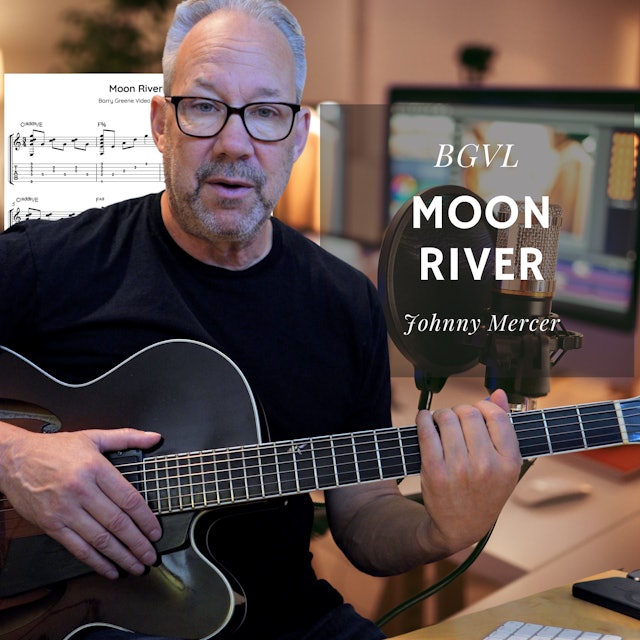
Moon River - Chord Melody
In this lesson, I walk you through my full process for arranging Johnny Mercer’s Moon River for solo guitar. Rather than simply teaching a finished arrangement, the focus is on understanding the musical decisions behind each phrase—so you can begin to develop your own voice in solo playing.
We ... -
Confirmation - Tune Based
In this lesson, we take a thoughtful look at Charlie Parker’s Confirmation, one of the most iconic and intricate bebop heads in the jazz repertoire. The melody poses unique challenges for guitarists, as Parker’s saxophone-specific phrasing and embellishments don’t always translate directly to the...
-
Jeannine - Tune Based
In this lesson, we take a close look at Duke Pearson’s classic tune Jeannine. The piece presents a compelling opportunity to explore modal harmony and the expressive use of pentatonic scales, with special attention given to the unusual shift from Ab minor to Ab major. We also break down the more ...